How to show up in ChatGPT with under 100 reviews: the website triples your odds
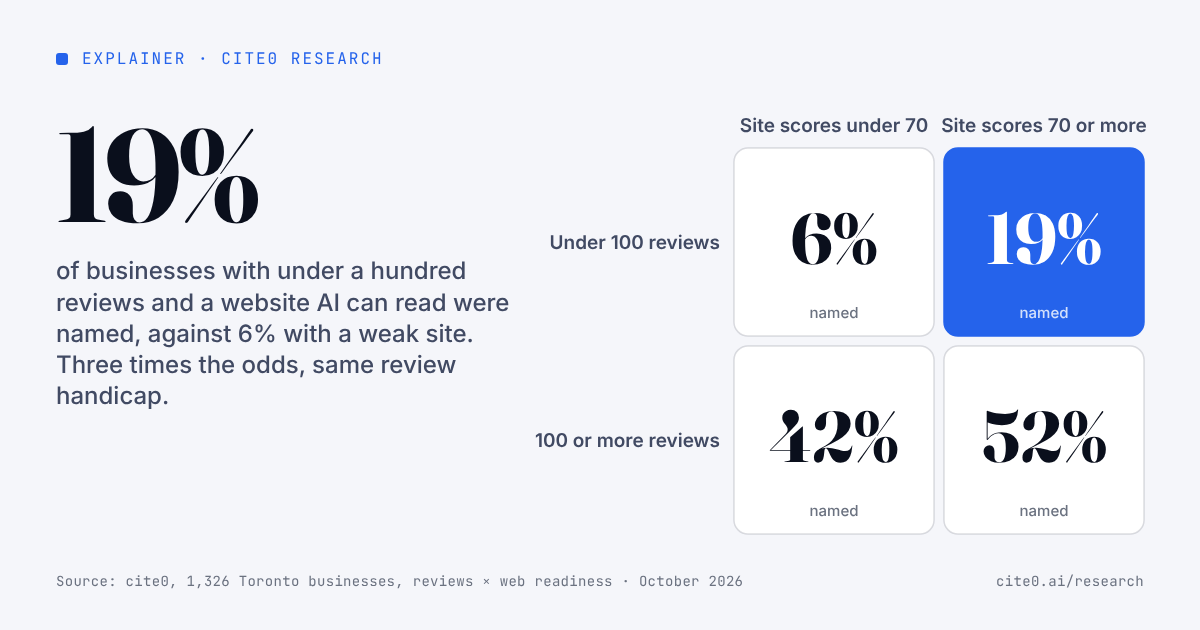
Among Toronto beauty businesses with fewer than a hundred Google reviews, the ones whose websites scored seventy or better on our readability check were named by ChatGPT 19% of the time; the ones with weaker sites, 6%. Above a hundred reviews the gap shrinks to 52% against 42%, small enough to be chance. Reviews get a business into the conversation. For everyone still earning them, how to show up in ChatGPT is a website question.
Can a business with under 100 reviews show up in ChatGPT?
Yes — 19% of such businesses were named when their website scored seventy or better, against 6% when it did not. Three times the rate, inside a group with the same review handicap, and a difference our sample is large enough to call real.
That is the one controlled comparison in our Toronto data. Everywhere else, the businesses ChatGPT names have more reviews and better sites and more photos all at once, and we cannot say which did the work. Hold reviews roughly constant and the website is what is left, and it still separates the named from the unnamed by a factor of three.
The score in question is cite0's web readiness check, which reads a site the way an AI assistant does: can it get in, can it find the main page, can it tell what the business is and where, is there something it can quote. Seventy is the line we drew through the middle of the scores, not a threshold the assistant applies; what sits on either side of it is the subject of "Is your website blocking AI crawlers?" on this hub.
Why does the website matter more for a smaller business?
Because above a hundred reviews the website stops separating anyone: 52% named with a strong site, 42% with a weak one. A business with hundreds of reviews is already in the conversation. It gets named for being talked about, and a mediocre site does not keep it out.
A business with thirty reviews has no such cushion. When the assistant goes looking for reasons to include it, the website is most of what there is to find. In 68% of the businesses ChatGPT named, at least one answer cited the business's own site as a source; for a small business, the site is often the evidence.
Across all 1,326 businesses, naming rises with every quarter of the readiness score: 9% named in the lowest quarter, then 20%, 26%, 33%. Not a cliff, a slope: no single fix puts a business in, and every one moves the odds. Reviews take a year of asking. The site is the one you can move this month.
What does "a website AI can read" mean, in plain words?
Getting in comes first, and 11% of unnamed businesses' sites turn AI assistants away at the door, against 1% of the named. Usually nobody chose that. It is a setting a web developer or a plugin switched on, and the owner has never seen it. An assistant that is refused moves on to the next clinic.
Then understanding. Once inside, the assistant is doing what a hurried customer does: looking for one line that says what this is, where it is, what it costs, and whether anyone has written something recent. A page with a clear main heading, a stated price, a visible date and a plain statement of the business behind it gives the assistant something to quote. A page that is a logo, a slideshow and a booking button gives it nothing.
Each of those faults is more common on the sites of businesses ChatGPT never named, and each is measured, with the share on both sides, in the teardown of 962 Toronto beauty websites on this hub. This post is about why they matter more to you if your review count is still small; that one is the list.
How do you get your business on ChatGPT?
Check the door: 11% of unnamed sites are closed to AI, and the fix is one line a developer changes in a morning. Ask whoever built the site whether it lets AI assistants read it. If they do not know, that is the answer.
Then the five things on this list, each of which the named sites do more often than the unnamed, and none of which needs a redesign. Give every page one main heading that says what the page is. Put the business's name, address and what it does on the page in a form an assistant reads, not only in a logo. State a price, even a starting price. Date your pages and keep the date honest. Write headings that are the questions customers ask you at the desk.
We cannot promise any one of these gets you named; the data shows what the named businesses have in common, not what caused it. But the three times difference inside the under-a-hundred-reviews group is the closest thing to a controlled result we have, and every item on the list is on the right side of it.
cite0's web readiness check is the score in this post, run on your site: the door, the main heading, what the assistant can tell about you, what it can quote, each as a finding with the fix. Radar then asks your market's questions every week and tells you whether you were named. Plans from $99 USD a month.
See where you standCommon questions
Can I list my business on ChatGPT?+
There is no ChatGPT business listing to sign up for. In our Toronto med spa run it searched the web before every answer (0% of answers came without a search), so the way onto its list is to be findable and readable where it looks: your Google profile and your own website. Anyone selling a "ChatGPT listing" is selling something ChatGPT does not have.
Do I need to rebuild my website?+
Almost never. The differences in this data are basics (a heading, a stated price, a date, a setting that lets assistants in), not design. In our experience the gap between a score in the forties and seventy is a handful of those items and one conversation with whoever hosts the site.
Is this just SEO?+
The fixes overlap with good SEO, which is why they will not hurt you on Google. The outcome is different: an answer names about 5 businesses and a results page shows dozens, so a site that ranks respectably can still be absent from every answer. We measured the answers.
If I fix the site, will ChatGPT name me?+
We cannot promise it, and nobody honest can. We can say that among businesses with the same review handicap, the ones with readable sites were named three times as often, and that the assistant cited the named businesses' own sites in 68% of cases. Those are good odds to move toward.
What can't this comparison show?+
It is one assistant, ChatGPT, over one run per trade in one month, and the hundred-reviews split is a line we drew, not one the assistant uses. The under-a-hundred result is solid on this sample; the over-a-hundred result is not, and a bigger run may move either.
cite0 ran and paid for this measurement. We checked 1,326 Toronto med spa, laser hair removal and esthetics businesses with a Google listing against their trade's latest published ChatGPT run, 226 answered prompts in all, with web search on, in October 2026, and marked each as named or not. Each business's website was read by cite0's web readiness checks, the same exam a client's site takes, over 962 sites; site findings are over the 808 that could be read. We then split businesses by Google review count at a hundred and by readiness score at seventy, and compared naming rates in each cell with a two-proportion test. What it cannot tell you: cause, what a second assistant would say, or whether the pattern holds outside beauty, which we have not measured.
- cite0 — 1,326 Toronto beauty businesses, split by Google review count and web readiness score, against 226 ChatGPT answers — October 2026; the full comparison with counts and significance tests is the Who-AI-names report for Toronto beauty on this hub
- OpenAI, "Overview of OpenAI crawlers" — OpenAI's own description of the agents that fetch pages for ChatGPT and how a site allows or refuses them, the setting the "door" section is about
- Aggarwal et al., "GEO: Generative Engine Optimization", KDD 2024 — the one controlled study of page changes in a generative engine; found that adding statistics, quotations and cited sources raised a page's visibility by up to 40%