Is your website blocking AI crawlers? 962 Toronto beauty sites, read the way AI reads them
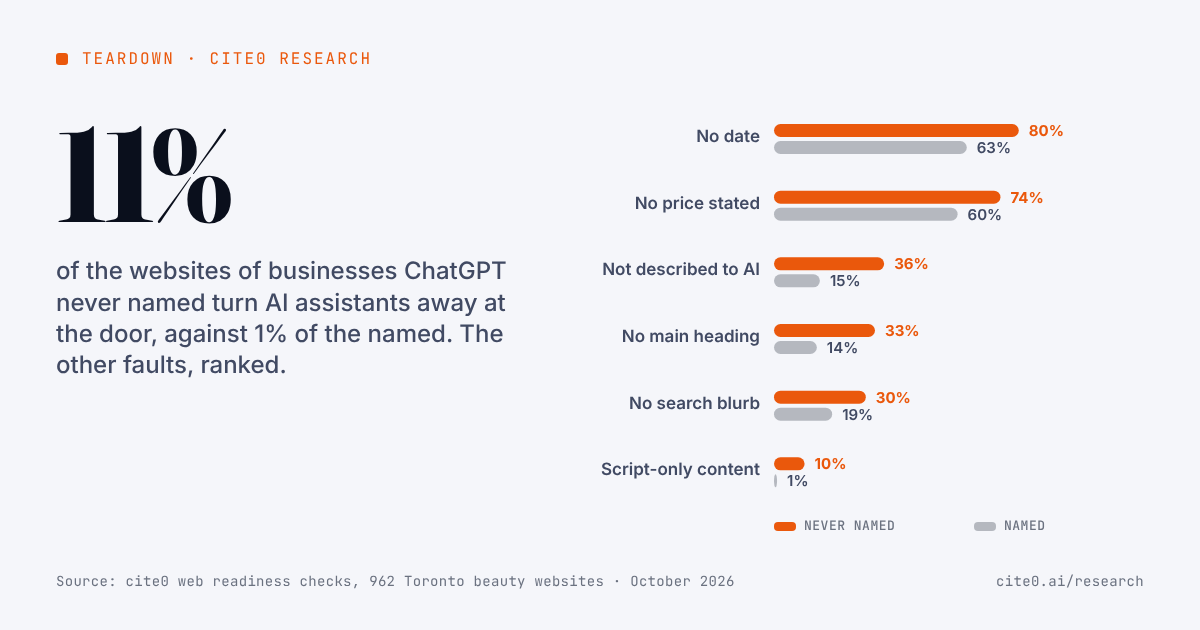
Often, and without the owner knowing: 11% of the websites of Toronto beauty businesses ChatGPT never named turn AI assistants away, against 1% of the ones it named. We read 962 med spa, laser and esthetics websites the way an assistant does. Named businesses' sites score a typical 76 on our readiness check, the rest 66, and the faults that separate them are basic.
Can an AI assistant read these websites at all?
Mostly — 808 of the 962 sites could be read, and the gap between the two groups is at the door. Among businesses ChatGPT never named, 11% of websites turn AI assistants away with a setting; among the named, 1%.
That setting is rarely a decision. It ships switched on in some site builders and security plugins, and the owner sees a working website and assumes the rest of the world does too. It refuses AI crawlers, the programs assistants send to read pages, by name; OpenAI's is called GPTBot, which is the word to ask your developer about. An assistant that is refused at the door does not try the window. It moves on to the next clinic, and it can only describe you from what other people have written.
The second way in is blocked more quietly. Some sites show nothing until the visitor's browser runs the site's scripts: fine for a person, blank for anything reading the raw page, which is how assistants read. Of the unnamed sites that could be reached, 10% work that way. Among the named it is 1%. A laser clinic built that way has a beautiful site that, to ChatGPT, is an empty page with a logo.
What do the unnamed sites get wrong most often?
The page does not say what it is: 36% of unnamed sites give an assistant no readable statement of the business, against 15% of the named. That is the largest gap in the list, and it is not about design. It is a few lines, invisible to a visitor, that tell a machine "this is a medical spa at this address, open these hours".
Next, the main heading. 33% of unnamed sites have no single main heading on the page, against 14% of the named; another 25% have several, which leaves an assistant looking for the one line that sums up the page with no clear answer.
Then three things a customer would also notice were missing. A date: 80% of unnamed sites put no date on their content, against 63% of the named. A price: 74% of unnamed sites state no price anywhere, against 60%. The line under your name in a search result: 30% of unnamed sites leave it blank, against 19%.
What does nearly every site miss, named or not?
A summary near the top: 96% of unnamed sites have none, and 95% of named sites have none either. The two or three plain sentences that say who you are, what you do and for whom, before the hero image and the booking button — almost nobody in Toronto beauty has written them.
The same is true of a named author on the content (83% of unnamed sites and 81% of named sites have none) and of headings written as the questions a customer asks (62% and 68% have none). These did not separate the named from the unnamed in our data, because nobody is doing them.
That makes them the open ground. The faults in the previous section are where the unnamed sites fall behind the named; these are where a business could get ahead of the named. A summary a reader can lift, a person who stands behind the page, headings that match what people ask: the evidence that these help comes from other markets and studies, and it is thin. But in Toronto beauty, the field is empty.
Which fixes are cheapest, and which trade needs them most?
Every fault here is an afternoon's work; laser hair removal shows the gaps sharpest, with 77% of unnamed laser sites undated against 31% of the named. On price it is 74% against 38%; on a preview card when the link is shared, 51% against 12%. The laser run was only 18 answers, so read those as a sketch that the three trades combined confirm, not a result on their own.
The order we would do them in, by cost: open the door to AI assistants (one line, ask your developer); one main heading per page that says what the page is; a price on every service page, even "from"; a visible date on anything that could go stale; and the few lines that tell a machine what the business is and where. The last one needs a developer or a plugin; the rest you can do in the editor you already use.
Nothing here is written for the engine. Google's own guidance says no special writing or code is needed for its AI answers, and our data agrees: the named sites are not clever, they are complete.
What does a score of 76 against 66 actually mean?
It means the typical named business clears seventy and the typical unnamed one does not — 76 against 66, median. 68% of named sites score seventy or more; 46% of unnamed sites do.
The score is cite0's web readiness check: a weighted count of the faults on this page and a few more, read from the site as an assistant would. Ten points between the medians is not a cliff. It is roughly the difference between a site with the main heading, the date and the price in place and one missing all three.
No single fault keeps a business out and no single fix puts it in. What the data shows is that a site with fewer of these problems is a site ChatGPT named more often, and that the problems themselves are the ones on this page. How the odds climb with the score, and why that matters most to a business still building its reviews, is in "How to show up in ChatGPT with under 100 reviews".
The scan in this post runs on your site in about a minute and lists each finding with its fix in these same words: the door, the heading, the price, the date, what the assistant can tell about you. Radar then asks your market's questions every week and tells you whether you were named. Plans from $99 USD a month.
See where you standCommon questions
Did you read my website?+
If you run a med spa, laser clinic or esthetics studio with an open Google listing in Toronto, probably. We do not publish per-site results, named or unnamed; the figures here are shares across groups. The same check run on your own site, with each finding and its fix, is what the scan does.
Is there ever a good reason to keep AI assistants out?+
It is a legitimate choice; some owners do not want their content in AI answers at all. The consequence is simply the one in this data: a site that refuses the assistant cannot be read by it, and 1% of the businesses ChatGPT named had made that choice.
Do the technical files aimed at AI help?+
We cannot say they do. Faults in those files show up more often among the named businesses in our data, which looks backwards until you notice that only a site that has the file can have a flawed one, and the named businesses were more likely to have built them at all. We have left them off the list above for that reason.
What can't this teardown show?+
Cause, and anything about a site we could not reach. The faults are more common on unnamed sites; we cannot show that fixing one gets a business named. The findings are over the 808 sites that could be read, from one assistant's answers, in one month.
cite0 ran and paid for this measurement. We took every open Google listing our catalogue holds for med spas, laser hair removal and esthetics services in Toronto, 1,326 businesses, and ran the website on each listing, 962 in all, through cite0's web readiness checks in October 2026: the same checks a client's site gets, with no business context, so every site is marked alike. 808 could be read; every finding in this post is a share of those. Each business was then marked as named or not by its trade's latest published ChatGPT run, 226 answered prompts across the three trades, and the two groups compared with a two-proportion test; every pooled fault above differs between them at the conventional level, and the laser figures are marked as the sketch they are. A check that could not run on a site is absent rather than counted as passed. What it cannot tell you: cause, what a second assistant would read differently, or anything about the sites that refused us.
- cite0 — web readiness checks over 962 Toronto beauty websites, compared by whether ChatGPT named the business in 226 answers — October 2026; the full comparison, with counts and significance tests, is the Who-AI-names report for Toronto beauty on this hub
- Google Search Central, "AI features and your website" — Google's statement that no special writing or markup is needed for its AI features, and that the ordinary fundamentals apply
- OpenAI, "Overview of OpenAI crawlers" — OpenAI's description of the agents that fetch pages for ChatGPT and how a site allows or refuses them