We asked ChatGPT 226 times about Toronto beauty. It named 15% of 1,326 businesses.
We asked ChatGPT 226 questions a Toronto beauty client would ask, about med spas, laser hair removal and brow, skin and esthetics studios, and checked 1,326 businesses with a Google listing against the answers. It named 15% of them at least once. The named have a typical 142 Google reviews; the rest have 25. Reviews separate the two groups most and rating hardly at all; for smaller businesses, the website decides.
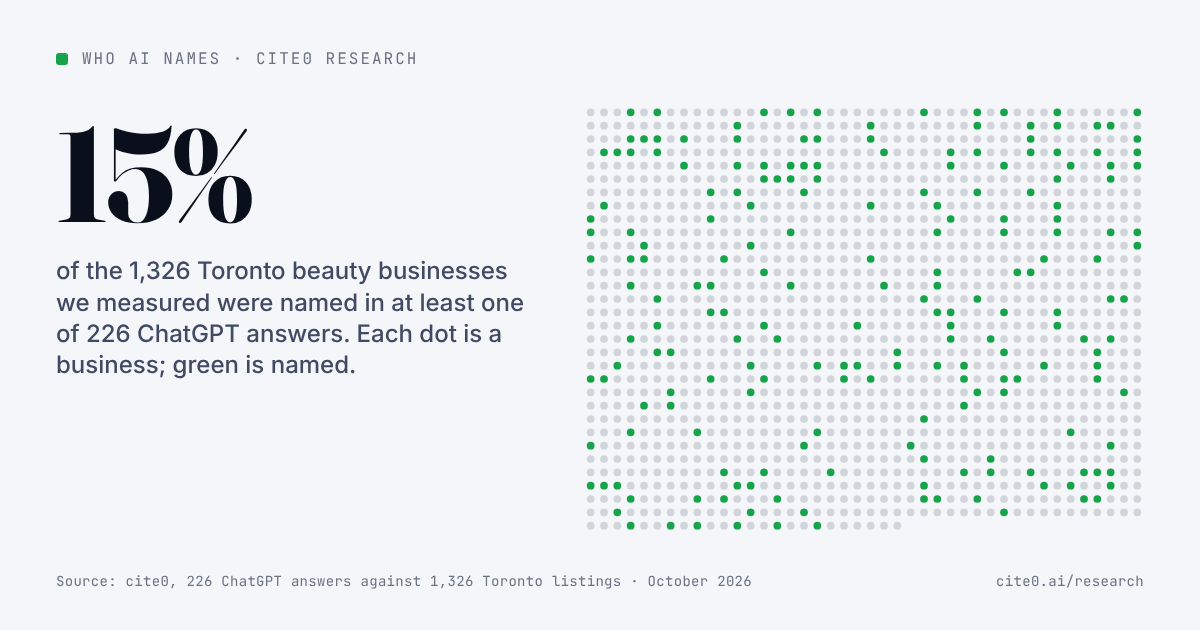
How many Toronto beauty businesses does ChatGPT name at all?
203 of the 1,326 businesses we measured were named in at least one answer: 15%. The other 1,123 were not named once, in any answer, for any question we asked.
The share moves by trade. Med spas did best, with 19% of 742 named. Laser hair removal clinics came in at 13%, and esthetics studios (brows, lashes, waxing, facials) at 9% of 418. Part of that gap is how many questions we asked: the med spa run was 155 answers, the laser run 18, and a business has more chances to be named when more questions are asked.
One more group sits outside the count. ChatGPT named 135 businesses for which we could find no Google listing at all, mostly doctors named personally and chains named by brand without a location. They have no rating, no reviews and no listing to compare, so they are left out of everything below. If your business trades under a practitioner's name, you may be in that group, and this report cannot see you.
Is it the businesses with the best ratings?
No: the named businesses' typical Google rating is 4.9 stars; the never-named sit at 5 stars, a perfect score. That is not a typo, and it stops being a paradox once you look at review counts. A business with a handful of reviews is very often sitting on a perfect rating; a business with hundreds almost never is.
Review volume is where the two groups separate. The named have a typical 142 Google reviews, the unnamed 25, roughly six times fewer. That is the widest gap of anything we measured, and it is the one input nobody can fix in an afternoon.
We cannot see inside ChatGPT, so we cannot say it counts reviews. What we can say is that review volume is the single feature that most reliably separates the two groups, and that a perfect rating on a short review history did not get a business named. How steeply the naming rate climbs with review count is in our Google Business Profile report.
What else separates the named from the rest?
Two things, and they stack: a complete Google listing and a website an AI assistant can read. On the listing, the sharpest single gap is the website link itself, which 99% of named businesses' listings carry against 68% of the unnamed. It is how an assistant gets from your listing to anything you wrote yourself.
On the website, the named businesses score a typical 76 on our check of how well an assistant can read a site; the unnamed score 66. And once an assistant can read a site, it uses it: in 68% of the named businesses, at least one answer cited the business's own website as a source. The assistant is not only hearing about these businesses from directories. It is quoting them.
The website turns out to matter most for the businesses that need it most. Among businesses with fewer than a hundred reviews, a readable site went with three times the naming rate; above a hundred reviews the website stopped separating anyone. That is the one controlled comparison in this data, and it has its own report ("How to show up in ChatGPT with under 100 reviews"), as do the faults on the unnamed websites. The listing and the site are what local SEO in Toronto has always worked on; they turn out to be what decided who ChatGPT named, too.
What about the well-reviewed businesses ChatGPT passed over?
There are 44 of them: businesses whose rating and review count both match or beat the typical named business in their own trade, and which no answer named. That is 4% of the unnamed, and they are the clearest losers in the data, because on the one thing everyone agrees matters, they are already ahead.
Their listings are as strong as the winners'. Their websites are not. Only 75% of their sites could be read by an AI assistant, against 89% of the named, and their typical web readiness score is 72 to the named businesses' 76. Their rating, 4.9, is the same as the winners'. Their typical review count, 204, is higher.
We report that group as a count on purpose. Naming a business for not being named is not something this report does, and the hub's rule is that who was not named is a number, never a list. If you suspect you are in it, the question to ask is not about your reviews. It is whether an assistant can read your website at all.
If you are one of the 1,123, the first question is which of the two gaps is yours, the listing or the website. cite0 checks your Google profile and reads your site the way an assistant does, then Radar asks your market's questions every week and tells you whether you were named. Plans from $99 USD a month.
See where you standCommon questions
How many questions did you ask, and were they about my business?+
226 answered questions across 3 collection runs in October 2026, one run per trade: 155 about med spas, 18 about laser hair removal and 53 about esthetics. The questions are the ones our prompt pack holds for each trade: the way a Toronto customer would ask an assistant where to go, what it costs and who is good for a specific concern. The laser and esthetics runs are thin, so their per-trade figures lean on the three trades combined. None of the questions named a business: a business is "named" when an answer brought it up on its own, and not being named does not mean ChatGPT would deny knowing you if asked directly.
Is this Toronto or the whole GTA?+
The questions say Toronto, and the businesses are the open Google listings our catalogue holds for each trade in the Toronto market. A clinic in Vaughan or Mississauga can still be named, since the assistant decides what counts as Toronto, and a chain named by brand counts as named at every location we hold, which weights chains up.
What can't this data show?+
Cause. Big, established businesses have more reviews, better sites and more photos at the same time, and we cannot pull those apart with one run of one assistant. The comparison inside the under-100-reviews band is the one controlled look we have. The next runs, with more weeks and with Gemini and Google's AI answers alongside ChatGPT, will tell us how stable these shares are.
Can I cite these AI search statistics?+
Yes. Cite "cite0, Who ChatGPT names in Toronto beauty, October 2026" with a link to this page. Every figure here is in the data note behind it with its counts and a significance test, so a number you quote can be checked. When the next run lands, this page is updated and the date says so.
How do I find out whether I was named?+
Radar asks your market's questions every week and records whether you were recommended, mentioned or absent, and who was named instead. That is the one product line in this report; the price is in the box below.
cite0 ran and paid for this measurement. The population is every open Google listing our catalogue holds for med spas, laser hair removal and esthetics services in the Toronto market, 1,326 businesses, plus the businesses ChatGPT named that a category sweep had missed, found by name. Each trade was checked against its latest published collection run: 226 answered prompts in all, from ChatGPT with web search, between 20 and 23 October 2026. A business is named when at least one answer in its trade named it. Google reputation (rating, review count, photos, claimed status, description, services) is read from the listing as bought. Websites were run through cite0's web readiness checks, the same exam a client's site takes, over 962 sites, of which 808 could be read; site findings are over those. Every share is reported with its counts and a significance test in the data note behind this post. What it cannot tell you: why a business was named, how a second run or a second assistant would differ, or anything about the 135 businesses named without a findable Google listing. One assistant, one run per trade, in one month.
- cite0 — 226 ChatGPT answers collected for Toronto med spa, laser hair removal and esthetics prompts, checked against 1,326 Google listings and 962 websites — October 2026; every figure with its counts and a two-proportion test in the data note, regenerated from the leads database on each run
- Google Business Profile Help, "How to improve your local ranking on Google" — Google's own statement that complete, accurate listings and review count and quality factor into local results — the listing features we measured are the ones it names
- Aggarwal et al., "GEO: Generative Engine Optimization", KDD 2024 — the one controlled study of what gets a page cited in a generative engine; it tested page content, not listings, so it informs the website section only