What is AI visibility for a local business? We measured 1,326 in Toronto, and 15% have it
AI visibility is whether an assistant such as ChatGPT names your business when a customer asks it for one like yours. We measured it the only way it can be measured, by asking, across 226 questions about Toronto beauty businesses. Of 1,326 businesses with a Google listing, 15% were named at least once; 1,123 were never named. The term sounds like marketing. The number behind it is not.
What is AI visibility for a local business?
It is the share of a market's questions in which an assistant names you — for Toronto beauty, 15% of businesses had any at all. When someone asks ChatGPT "where should I get laser hair removal in Toronto", the answer is a short list of real businesses. You are on it, you are mentioned in passing, or you are absent. That is the whole measurement.
It is not a score a vendor assigns you, and it is not the same as being findable. ChatGPT may well know your business exists; the question is whether it brings you up unprompted when a customer describes what they need. In our run, 203 businesses were named in at least one answer and 1,123 were named in none: not once, across every question we asked about their trade.
The marketing trade has acronyms for the work of improving it, explained in the questions at the end. The thing itself is simple to say plainly: getting named by AI when your customer asks.
How is it different from showing up on Google?
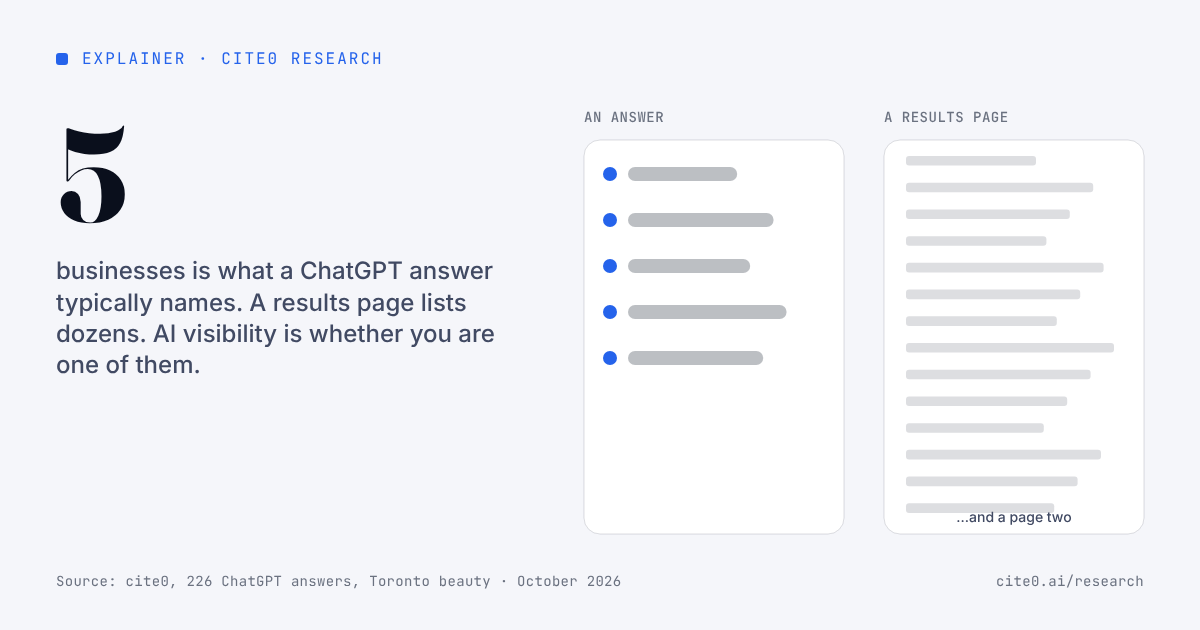
An answer names a handful of businesses — a typical 5 in our Toronto med spa questions — where a results page lists dozens. A list that short does not degrade gracefully. You are in it or you are not, and there is no page two.
That makes the outcome lopsided. In the med spa run, the single most-named clinic appeared in 40 of 155 answers, roughly a quarter of everything ChatGPT said about med spas in Toronto that week, while 598 of 742 med spas with a Google listing appeared in none.
The other difference is that the assistant does the choosing. In an answer the comparison has already happened, using whatever the assistant could read about each business, and what it could read is the part you control.
What did the businesses with AI visibility have that the rest did not?
Two things, mostly: 64% of the named businesses have a hundred or more Google reviews, against 18% of the unnamed, and the named businesses' websites could be read by an AI assistant more often, 89% to 83%. Rating did not separate them; the unnamed group's typical rating is the higher one.
Each lever has its own report on this hub: the Google Business Profile comparison, the teardown of 962 websites, and what changes for a business with under a hundred reviews.
We can say these features are more common among the named. We cannot say they caused the naming: one run, one assistant, and the big established businesses tend to have all of them at once.
How do you measure your own?
Ask the assistant your customers' questions, many times, and write down who it names — we asked 226 times for the figures above. One answer is not a measurement. The same question asked twice in a week can return different names, so a single screenshot of ChatGPT recommending you, or not, tells you very little.
Done by hand, that is an afternoon a week: twenty or thirty questions in a customer's words, asked on a schedule, names recorded, and ideally asked of more than one assistant, because they do not agree. The useful output is not a score. It is three lists (the questions you were named for, the ones you were not, and who was named instead) and a reason for the gap you can act on.
Radar is the measurement in this post, run every week: your market's questions asked of the assistants, and whether you were recommended, mentioned or absent, beside who was named instead. The web and profile checks tell you which gap is yours. Plans from $99 USD a month.
See where you standCommon questions
Is AI visibility the same as SEO, AEO or GEO?+
AEO (answer engine optimization) and GEO (generative engine optimization) are the marketing trade's names for the work of improving AI visibility; they describe the same thing. SEO is different. The inputs overlap and the outcome does not. The same listing and the same website feed both, which is why the fixes look familiar. But a results page shows dozens of businesses and an answer shows about 5; a business can hold a respectable Google position and still be absent from every answer. That second thing is what this measures.
Do my customers actually use ChatGPT to choose a clinic?+
We did not measure that here and will not guess at it. What we measured is what the assistant says when asked, and that it names a small, consistent group. Whether your customers ask it is a question for your front desk; the answer there has changed quickly in the last year.
Can I check this myself for free?+
Yes, roughly. Open ChatGPT, ask three of the questions a customer would ask about your trade in your area, and see whether you appear. Do it again next week. If you appear in some and not others, you are seeing the same variation we see; the measurement is the share, not any one answer.
What can't this number tell me?+
Why. We know which businesses were named and what they have in common; we do not know what ChatGPT weighed. It also cannot tell you about Gemini, Perplexity or Google's AI answers, which we did not ask in this run, or how stable the share is over months, which the next runs will show.
cite0 ran and paid for this measurement. We asked ChatGPT, with web search on, 226 questions from our prompt packs for med spas, laser hair removal and esthetics services in Toronto, between 20 and 23 October 2026, and recorded every business each answer named. We then checked 1,326 businesses with an open Google listing in those trades against the answers: a business is named when at least one answer in its trade named it. Reviews and ratings come from the Google listing; the website figures come from cite0's web readiness checks over 962 sites. The laser and esthetics runs were small, so the shares here combine the three trades. What it cannot tell you: why any business was named, or what a second assistant or a second week would say.
- cite0 — 226 ChatGPT answers for Toronto beauty prompts, checked against 1,326 Google listings — October 2026; the full comparison is the Who-AI-names report for Toronto beauty on this hub
- Google Search Central, "AI features and your website" — Google's statement that no special writing or markup is needed for its AI answers — the same ordinary fundamentals apply